
Recovery Standard

Governing rules for restoring legibility, integrity, and operational capability when systems fail, drift, or collapse.

ACE INTL MEDIA — RECOVERY STANDARD

The Recovery Standard defines how systems across the Ace Intl Media Network are restored when architectural clarity collapses due to failure, drift, or disruption.

This standard operates under the Infrastructure Doctrine Framework and complements the Architecture Standard and Continuity Standard .

It applies to all systems designed, delivered, operated, or maintained by Ace Intl Media .
1. Purpose

Recovery is the restoration of understanding.

A system that returns to service without restored clarity is not recovered — it is operating in an accidental state.

Recovery exists to re-establish intent, boundaries, dependencies, and accountability before normal operation resumes.

2. Recovery Principles

2.1 Recovery Restores Narrative, Not Just Service

A system is recovered only when its intent, boundaries, dependencies, behaviour, and documentation are once again coherent.

2.2 Recovery Must Be Repeatable

Recovery cannot depend on memory, improvisation, individual expertise, or undocumented steps.

2.3 Recovery Must Be Pre-Designed

Recovery is not invented during incidents. Every system must have a maintained recovery blueprint.

2.4 Recovery Must Be Executable Under Stress

Procedures must be linear, unambiguous, low-cognitive-load, and free of branching logic.

2.5 Recovery Must Expose Root Causes

Recovery must surface, document, and correct root causes. Workarounds are not recovery.

3. Recovery Requirements

3.1 Recovery Blueprint

Every system must maintain a version-controlled recovery blueprint stored in the portal.

3.2 Recovery Triggers

Recovery is initiated when systems become unexplainable, documentation diverges, dependencies fail, or operators express uncertainty.

3.3 Recovery Execution

Operators must follow the blueprint exactly, document deviations, capture evidence, and escalate narrative gaps.

3.4 Recovery Evidence

Evidence is mandatory and forms part of the permanent recovery record.

3.5 Recovery Verification

Recovery is verified only when documentation, architecture, continuity posture, and operator understanding are restored.

4. Recovery Artifacts

  • Recovery Report — trigger, timeline, actions, deviations, evidence, outcome.
  • Root Cause Record — underlying causes and architectural implications.
  • Remediation Plan — corrective actions, owners, deadlines, verification.
  • Post-Recovery Architecture Review — structural validation.

5. Recovery Testing

Recovery testing validates that recovery is possible without improvisation, even under stress.

Tests occur after major change, dependency updates, drift correction, and at minimum annually.

6. Recovery Remediation

Remediation restores systems to a state where recovery is possible, repeatable, documented, and validated.

Systems that cannot be restored to legibility are retired.

7. Enforcement

All systems must maintain a recovery blueprint, recovery history, test history, and verified recovery path.

Violations trigger immediate review and remediation.

8. Definition of Recovered

A system is recovered only when:

  • It is explainable
  • It is documented
  • It is owned
  • It is bounded
  • It is continuous
  • It is structurally legible

Recovery is the restoration of understanding, not merely the resumption of service.

A system that is operational but cannot be confidently explained, validated, or governed remains in a degraded state and is not considered recovered under this standard.

Recovery is complete only when operators can reason about the system without reliance on guesswork, memory, or undocumented assumptions.

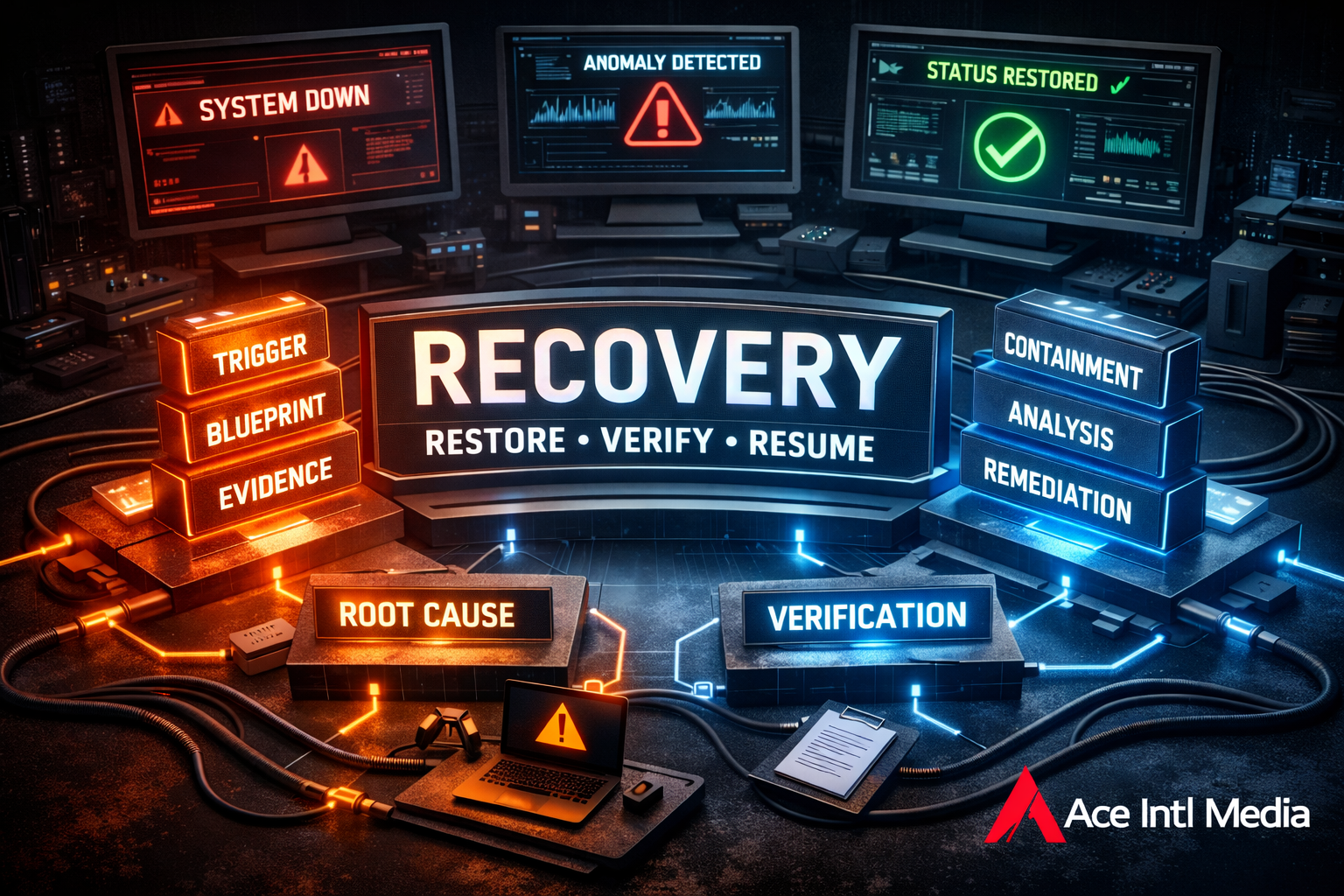
9. Recovery Model

Recovery Standard model illustrating triggers, recovery blueprints, evidence capture, verification, and remediation

Frequently Asked Questions

What is the purpose of the Recovery Standard?

The Recovery Standard defines how systems are restored when failure, drift, or loss of clarity occurs. It ensures that recovery restores understanding, integrity, and governance — not just service availability.

How is recovery different from continuity or failover?

Continuity focuses on keeping services running. Recovery focuses on restoring architectural legibility, documentation accuracy, and operator confidence after disruption.

When is recovery triggered?

Recovery is triggered when systems become unexplainable, documentation diverges from reality, dependencies fail, continuity tests fail, or operators express uncertainty.

Is service restoration enough to consider a system recovered?

No. A system is considered recovered only when it is explainable, documented, owned, bounded, continuous, and structurally legible. Service without clarity is treated as failure.

Who is responsible for recovery?

Each system has a named steward responsible for recovery execution, verification, documentation updates, and ensuring recovery standards are met before normal operation resumes.

What happens if recovery cannot restore legibility?

If legibility, ownership, or structural understanding cannot be restored, the system is retired or rebuilt. Operating an ungovernable system is not permitted.

Does the Recovery Standard apply to all systems?

Yes. The Recovery Standard applies to all systems designed, delivered, operated, or maintained by Ace Intl Media, regardless of scale or technology stack.

Is recovery testing mandatory?

Yes. Recovery testing is required to validate that recovery is possible without improvisation and that recovery blueprints remain accurate and executable under stress.