Continuity Standard

Rules for maintaining legibility, ownership, and survivability across the full lifecycle of every system.

ACE INTL MEDIA — CONTINUITY STANDARD

The Continuity Standard defines how systems across the Ace Intl Media Network remain explainable, operable, and recoverable over time.

Continuity exists to prevent silent failure — the gradual loss of architectural clarity caused by undocumented change, dependency drift, ownership erosion, and operational complacency.

This standard operates under the Infrastructure Doctrine Framework and is enforced alongside the Architecture Standard and the Recovery Standard .

It applies to all systems designed, delivered, operated, or maintained by Ace Intl Media , including infrastructure, platforms, applications, and client environments.

1. Purpose

Continuity ensures that systems remain explainable, governable, and recoverable long after initial deployment — not only when they are actively developed or closely monitored.

Continuity preserves architectural truth over time. It prevents the slow erosion of clarity caused by incremental change, undocumented decisions, staff turnover, and unmanaged dependencies.

Architecture defines how systems are built. Continuity defines how systems remain alive, legible, and survivable across their full lifecycle.

A system that cannot be confidently explained at any point in its lifecycle is already in failure, regardless of uptime.

2. Continuity Principles

2.1 Continuity Is Structural, Not Operational

Continuity is not uptime, monitoring, patching, or maintenance. These are operational activities, not continuity guarantees.

Continuity is the preservation of structural clarity: original intent, defined boundaries, clear ownership, accurate documentation, and verified recovery capability.

If any of these degrade, continuity has failed — even if the system remains operational.

2.2 Ownership Must Persist

A system without an active steward is a system in decay. Stewardship is an active responsibility, not a title.

Ownership includes architectural integrity, documentation accuracy, boundary enforcement, drift detection, and recovery oversight.

Ownership cannot be shared, diluted, assumed, or implied. If ownership is unclear, continuity is suspended.

2.3 Drift Is the Primary Threat

Continuity collapses when architecture, documentation, and implementation diverge over time.

Drift includes undocumented changes, outdated diagrams, lost rationale, reliance on memory, and untested recovery paths.

Drift is treated as an early-stage failure condition and must be detected and corrected immediately.

2.4 Continuity Requires Active Verification

Continuity is not assumed and is never permanent.

It must be demonstrated through audits, recovery tests, documentation reviews, dependency checks, and operator interviews.

If continuity cannot be demonstrated on demand, it does not exist.

2.5 Recovery Is a Continuity Function

Recovery is governed by the Recovery Standard and is a core validation mechanism of continuity.

A system that cannot be recovered in a documented, repeatable, and explainable manner cannot be continuous.

3. Continuity Requirements

3.1 Stewardship

Every system must have a named steward with explicit authority and accountability for continuity compliance.

Stewardship includes maintaining architectural alignment, documentation currency, drift detection, and recovery readiness.

If stewardship lapses or becomes unclear, continuity is immediately suspended.

3.2 Documentation Currency

Documentation must reflect the system as it exists today, not as it was originally designed.

Documentation must be updated after change, recovery, dependency modification, and architectural review.

Historical documentation is archived and must never be reused as current truth.

3.3 Change Integrity

All changes must preserve system intent, boundaries, narrative coherence, and recovery capability.

Changes that introduce ambiguity, undocumented behaviour, or untraceable side effects are violations, regardless of outcome.

3.4 Dependency Continuity

Dependencies must remain continuously governable.

Each dependency must be identified, monitored, versioned, justified, and replaceable.

Opaque, abandoned, or unmaintained dependencies place continuity at risk.

3.5 Operational Legibility

Operators must be able to explain how systems operate across the cloud layer , the application layer , and the wider network.

If operators cannot explain the system without guesswork, continuity has failed.

4. Continuity Artifacts

Continuity is evidenced through maintained artifacts, including continuity ledgers, stewardship records, drift reports, and recovery test records.

These artifacts form the authoritative operational history of each system and are subject to audit and review.

5. Continuity Review

Continuity reviews are required when ownership changes, drift is detected, recovery fails, dependencies change, or operators express uncertainty.

Uncertainty is treated as evidence of continuity failure.

6. Continuity Remediation

Remediation restores continuity by restoring legibility.

Systems that cannot be restored to a governable state are retired or rebuilt.

7. Enforcement

This standard is mandatory for all systems, contributors, and environments across the Ace Intl Media Network .

Violations trigger immediate review and remediation.

8. Definition of Continuous

A system is continuous only when it is explainable, owned, documented, recoverable, drift-free, and structurally legible at all times — not only during normal operation, audits, or periods of active development.

Explainability means the system’s purpose, boundaries, dependencies, and behaviour can be clearly articulated without reliance on individual memory, assumption, or undocumented knowledge.

Ownership means a named steward retains active responsibility for architectural integrity, documentation accuracy, drift detection, and recovery readiness. Ownership that is implied, shared, or historical is invalid.

Documentation must reflect the system as it exists today. A system that functions correctly but cannot be accurately described is considered degraded under this standard.

Recoverability requires that recovery paths are documented, tested, repeatable, and executable without improvisation. A system that cannot be confidently recovered cannot be considered continuous.

Continuity is a maintained condition.

9. Continuity Model

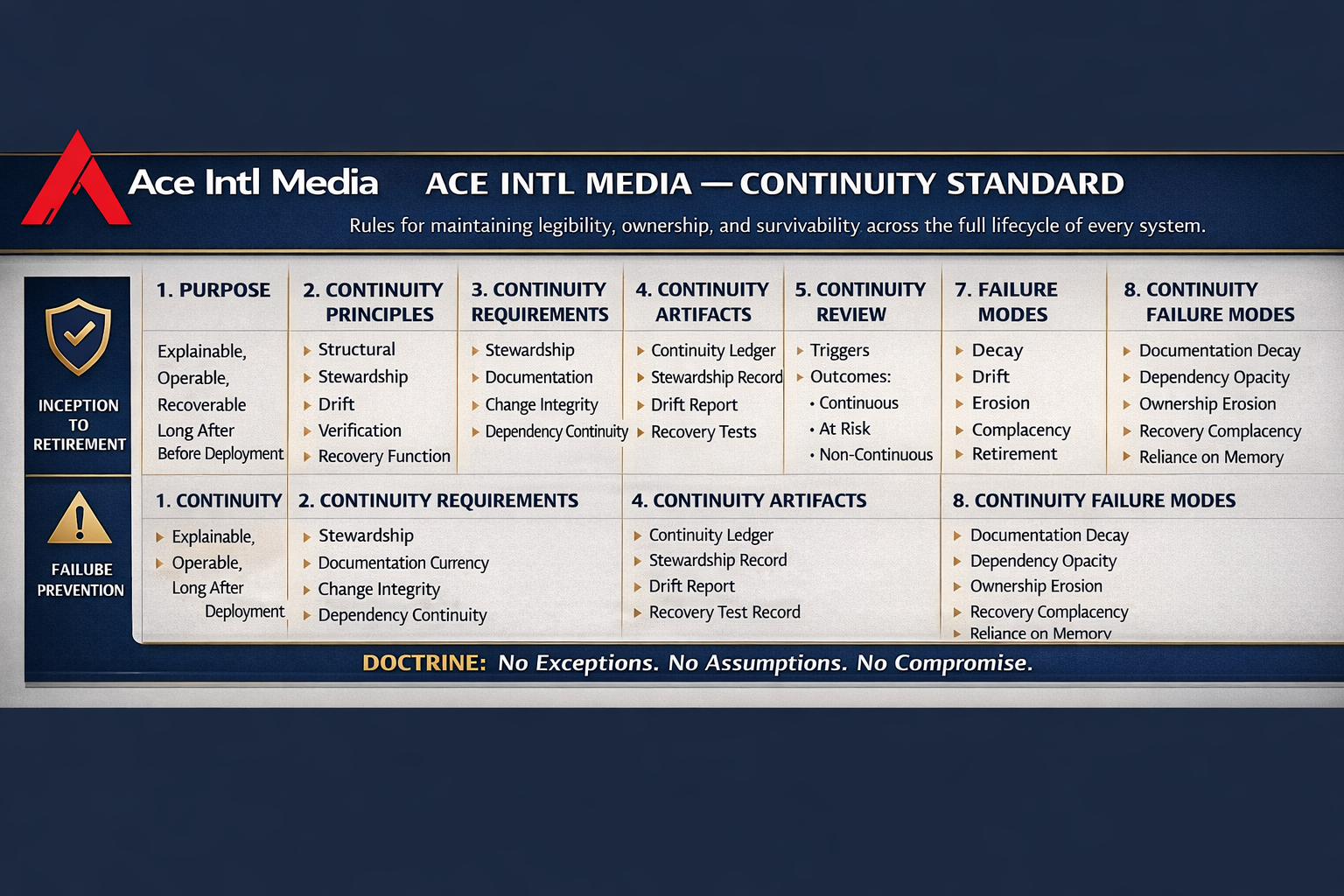
The Continuity Model illustrates how stewardship, drift detection, verification, recovery, and remediation interact to preserve legibility across the full system lifecycle.

Continuity Standard model illustrating stewardship, drift detection, verification, recovery, and remediation

Frequently Asked Questions

What is the purpose of the Continuity Standard?

The Continuity Standard ensures systems remain explainable, governed, and recoverable over time, preventing silent failure.

How does continuity differ from recovery?

Continuity preserves legibility over time. Recovery restores legibility after failure.

When does continuity fail?

Continuity fails when drift, undocumented change, or loss of ownership occurs.

Is continuity verification mandatory?

Yes. Continuity must be actively demonstrated, not assumed.

Who owns continuity?

Each system has a named steward accountable for continuity compliance.

What happens if continuity cannot be restored?

The system is retired or rebuilt. Operating ungovernable systems is not permitted.