Architecture Standard

Governing rules for designing systems that remain legible, recoverable, and structurally durable over time.

ACE INTL MEDIA — ARCHITECTURE STANDARD

The Architecture Standard defines how systems across the Ace Intl Media Network are designed to preserve intent, remain explainable, and survive change over time.

This standard operates under the Infrastructure Doctrine Framework and governs how systems delivered through Ace Intl Media are designed, evolved, and enforced.

It applies to all systems designed, delivered, operated, or maintained by Ace Intl Media, regardless of scale, lifecycle stage, or technology stack.

1. Purpose

Architecture exists to preserve intent.

Systems naturally accumulate complexity, drift, and undocumented assumptions. Architecture exists to ensure that original intent remains legible as systems evolve.

A system that cannot be clearly explained cannot be safely changed, reliably recovered, or responsibly owned, regardless of uptime or performance.

2. Architectural Principles

2.1 Intent-First Architecture

Architecture begins with documented intent, not tooling or implementation. Systems must explicitly define their purpose, exclusions, and survival conditions before design proceeds.

2.2 Hard Boundaries

Every system must define ownership, responsibilities, dependencies, and refusal conditions. Boundaries are structural controls that prevent accidental coupling.

2.3 Narrative Integrity

Architecture must preserve the story of the system, including rationale, constraints, rejected alternatives, assumptions, and expected failure modes.

2.4 Legibility as a Core Requirement

Systems must be understandable without reliance on tribal knowledge. If operators depend on memory rather than structure, legibility has failed.

2.5 Visible Degradation

Failure must be explicit and predictable. Silent degradation, hidden dependencies, and undocumented fallback paths are architectural violations.

2.6 Documentation as Infrastructure

Documentation precedes implementation, evolves with reality, and is validated through recovery. Drift between documentation and operation indicates architectural failure.

2.7 Minimal Surface Area

Architecture must minimise complexity, integration points, and abstraction layers. Simplicity increases survivability and reduces recovery time.

3. Architectural Requirements

Architectural requirements define the minimum conditions under which systems are considered governable, recoverable, and safe to evolve over time.

3.1 Ownership

Every system must have a named owner accountable for architectural integrity, documentation accuracy, boundary enforcement, and recovery readiness.

Systems without ownership drift rapidly and are treated as architecturally invalid.

3.2 Change Governance

All changes must preserve documented intent. Impact, boundaries, and recovery viability must be understood before change and revalidated after change.

Unexplained or undocumented change is treated as architectural corruption.

3.3 Drift Prevention

Drift occurs when documented architecture diverges from operational reality. It erodes legibility and undermines recovery.

Drift must be actively detected and corrected. It is a failure condition, not a cosmetic issue.

3.4 Dependency Governance

All dependencies must be explicit, documented, versioned, justified, and monitored.

Undeclared dependencies create hidden coupling and unpredictable failure behaviour.

3.5 Observability for Understanding

Observability exists to surface intent violations, boundary breaches, and early signs of silent degradation.

Metrics that do not improve understanding are insufficient.

4. Architectural Artifacts

  • System Charter — defines intent, scope, ownership, and refusal conditions.
  • Architecture Record — documents decisions, constraints, and trade-offs.
  • Interface Contracts — define expectations between systems.
  • Recovery Blueprint — defines how clarity and service are restored.

5. Architectural Review

Review is required when ownership changes, dependencies shift, boundaries erode, documentation drifts, recovery fails, or operators express uncertainty.

Operator uncertainty is treated as a signal of structural risk, not as an operational weakness.

6. Architectural Remediation

Remediation restores legibility before performance. Recovery of understanding, boundaries, documentation, and intent precedes optimisation.

7. Enforcement

This standard applies to all systems delivered, operated, or maintained by Ace Intl Media , across all environments and contributors. Non-compliance blocks deployment and triggers remediation.

8. Definition of Done

A system is considered complete only when:

  • It is explainable
  • It is recoverable
  • It is documented
  • It is owned
  • It is bounded
  • It degrades visibly

If any condition is unmet, the system is not done, regardless of delivery status.

Systems that fail these conditions are not considered deliverable under Ace Intl Media service standards .

Structural Closure

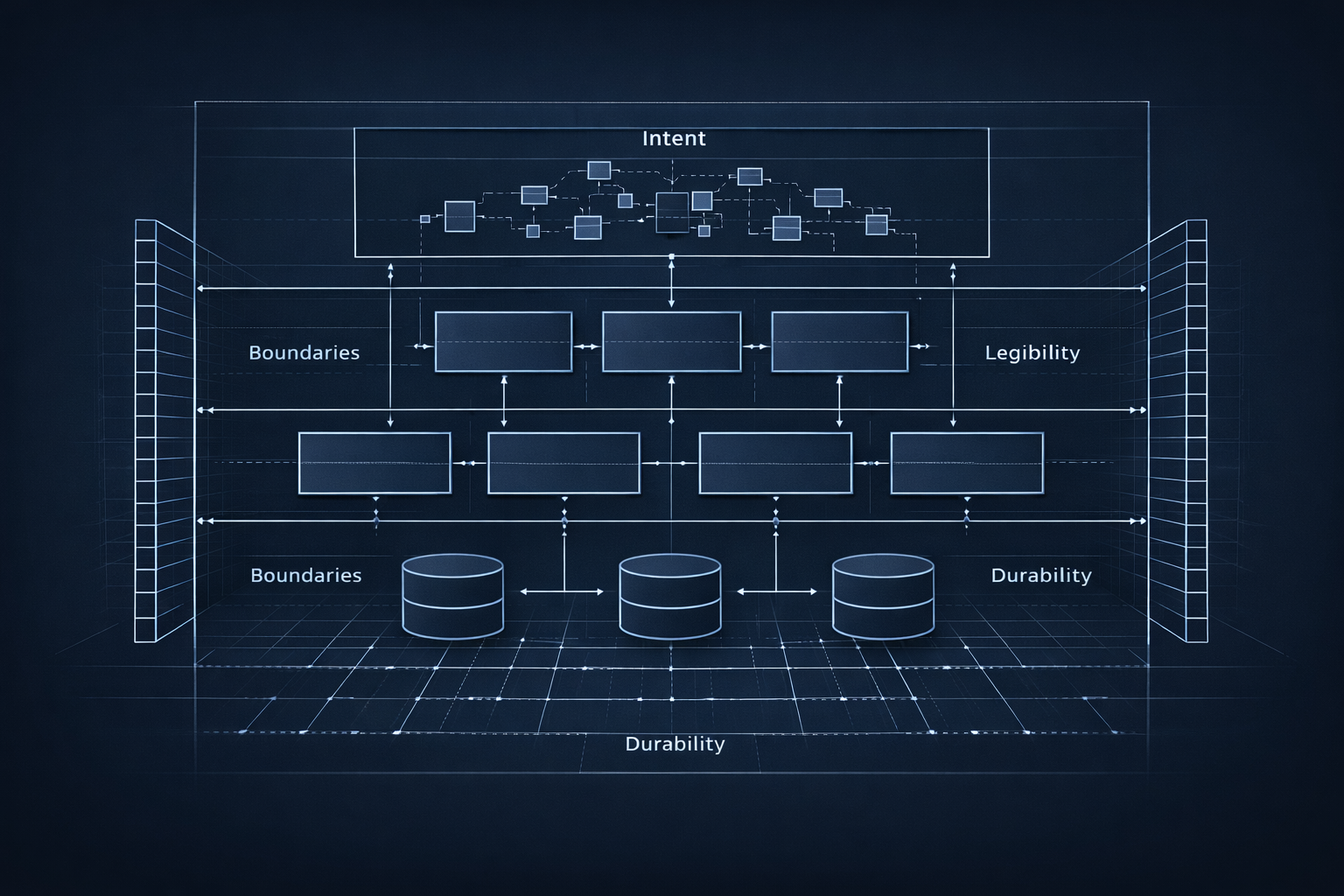
System architecture diagram illustrating intent, boundaries, legibility, and durability

Frequently Asked Questions

What is the purpose of the Architecture Standard?

The Architecture Standard defines the rules under which systems are designed, documented, governed, and evolved across the Ace Intl Media Network. Its purpose is to preserve intent, maintain legibility, and ensure systems remain recoverable over time.

How is this different from normal technical documentation?

Traditional documentation explains how systems work. The Architecture Standard defines the conditions under which systems remain understandable, governable, and safe to change. Documentation is treated as a structural component, not supporting text.

Does this standard apply to all systems?

Yes. The standard applies to all systems designed, delivered, operated, or maintained by Ace Intl Media, regardless of scale, technology stack, or lifecycle stage.

Who is responsible for enforcing the Architecture Standard?

Every system governed by the standard has a named owner responsible for architectural integrity, documentation accuracy, boundary enforcement, and recovery readiness. Enforcement is architectural, not individual.

What happens if a system does not meet the standard?

Systems that fail to meet the standard are considered architecturally incomplete. Non-compliance blocks deployment and triggers remediation until legibility, ownership, and recovery conditions are restored.

How does the Architecture Standard handle change?

All change must preserve documented intent. Impact, boundaries, and recovery viability must be understood before change and revalidated after change. Unexplained change is treated as architectural corruption.

What is considered a failure under this standard?

Failure is not limited to downtime. Loss of legibility, undocumented dependencies, silent degradation, or reliance on tribal knowledge are treated as architectural failures.

Does this standard replace monitoring or observability tools?

No. Monitoring tools report system behaviour. The Architecture Standard governs system understanding. Both are required, but they serve different purposes.

Is this standard client-facing or internal?

The principles and intent are public-facing to set expectations. Enforcement details, internal records, and recovery artefacts are maintained internally as part of governance and operations.

Can the Architecture Standard evolve over time?

Yes. The core principles are stable, but the standard evolves through governed change. Updates are versioned, documented, and reviewed to prevent erosion of clarity or intent.