Network Standard

A client-safe doctrine describing how Ace Intl Media designs, governs, and protects network environments that support live systems.

ACE INTL MEDIA — NETWORK STANDARD

A clear, authoritative doctrine describing how Ace Intl Media designs, governs, and protects the network environments that support client systems.

This standard is published through the Ace Intl Media Network to provide transparent, client-safe visibility into how environments are structured, segmented, and governed — without exposing internal operational detail.

1. What This Standard Is

Ace Intl Media’s network layer is not generic hosting. It is a governed, infrastructure-grade environment defined by the Architecture Standard and operated under the Operational Standard.

The network is engineered for:

  • stability
  • security
  • predictability
  • controlled exposure
  • long-term survivability

Clients operate on top of this network — not inside it. This standard explains the network in a way that is transparent, visual, and client-safe.

2. Core Principles

2.1 Clarity First

Every part of the network must be explainable:

  • how it is structured
  • how it is segmented
  • how traffic flows
  • what is exposed and what is protected

2.2 Boundaries Protect Everything

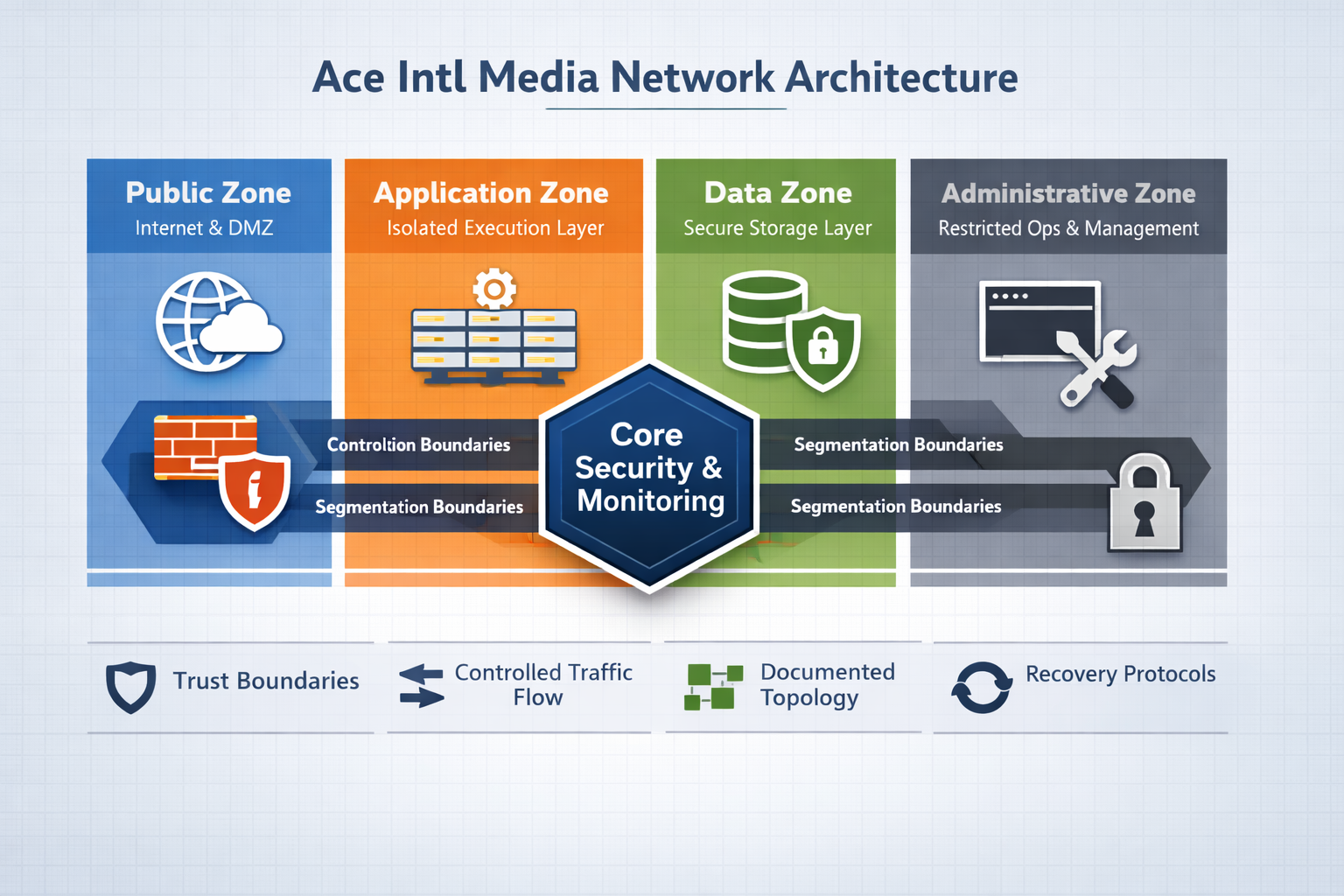
The network is divided into controlled zones:

  • Public Zones — intentionally exposed
  • Application Zones — isolated execution layers
  • Data Zones — protected storage layers
  • Administrative Zones — restricted operational surfaces

Boundary enforcement follows the Operator’s Handbook.

2.3 Predictable Behavior

  • no hidden paths
  • no accidental dependencies
  • no unpredictable routing

2.4 Visible Degradation

  • latency
  • routing anomalies
  • boundary violations
  • dependency failures

2.5 Built-In Recoverability

Recovery is documented, tested, and repeatable under the Recovery Standard.

3. How the Network Is Structured

3.1 Segmented by Design

The network is intentionally segmented to reduce risk, preserve predictability, and prevent uncontrolled propagation of failure.

Segmentation separates:

  • public exposure
  • application logic
  • data storage
  • administrative control

Each zone has a defined role and operates within enforced boundaries. No zone implicitly trusts another.

3.2 Controlled Exposure

Only components that must be public are exposed. Everything else is protected behind firewalls, identity layers, and access controls.

Exposure is intentional, documented, and limited to necessity. Accidental or inherited exposure is not permitted.

3.3 Documented Topology

The network topology is documented in a client-safe form that explains structure, boundaries, and traffic flow without exposing internal operational detail.

Topology documentation is published through the Network Index to preserve transparency while maintaining security.

4. How the Network Is Governed

4.1 Change Control

All network changes are reviewed, documented, tested, and approved under the Continuity Standard.

4.2 Continuous Monitoring

  • performance
  • anomalies
  • boundary violations
  • dependency failures

4.3 Dependency Governance

Every external dependency is known, justified, monitored, and replaceable.

5. Security Model

The network follows zero-trust principles aligned with NIST Zero Trust Architecture and ISO/IEC 27001 , without claiming certification unless explicitly stated elsewhere.

No part of the network is implicitly trusted. Access is granted based on verified identity, context, and policy, rather than network location or assumed privilege.

Only essential services are exposed. Everything else is isolated and protected through segmentation, identity controls, and enforced access boundaries.

6. Continuity & Recovery

Network continuity and recovery procedures are governed by the Recovery Standard and validated through regular testing.

7. What This Means for Clients

Your systems are supported by a network governed and operated by Ace Intl Media , using documented, reviewable standards rather than opaque agency practices.

8. Definition of a Compliant Network

  • clear
  • segmented
  • secure
  • documented
  • monitored
  • recoverable

This is the standard Ace Intl Media guarantees.

Network Standard — Architecture & Segmentation Model

Ace Intl Media network standard showing segmented zones, controlled exposure, and governed boundaries

Network Standard – Frequently Asked Questions

Is this network just standard hosting?

No. The Ace Intl Media network is a governed, infrastructure-grade environment designed under the Architecture Standard. It is not shared, unmanaged, or generic hosting.

Can clients directly access or modify the network?

No. Clients operate on top of the network, not inside it. Network access and changes are governed under the Operational Standard.

How is security enforced across the network?

Security is structural. The network enforces segmentation, identity controls, and zero-trust principles. No zone is inherently trusted.

What happens if something goes wrong?

Failures must be visible. Recovery follows the Recovery Standard, ensuring documented and reversible restoration.

Are network changes made on the fly?

No. All network changes are reviewed, documented, tested, and approved under the Continuity Standard. Undocumented changes are not permitted.

Does this documentation expose sensitive information?

No. This network documentation is client-safe and audit-ready. It explains structure and governance without exposing credentials, internal IPs, or configuration details.

Why is this documentation public?

Ace Intl Media publishes its standards to allow external review, confidence, and accountability without requiring privileged access. Transparency is structural, not promotional.